
Marshall Pailet is an award-winning writer and director whose work is known for blending inventive storytelling with emotional depth. His latest musical, Private Jones, tells a remarkable story inspired by a deaf Welsh sniper, combining spoken English, British Sign Language and dynamic captioning to create a truly accessible theatrical experience.
Ahead of the show’s run, we caught up with Marshall to talk about the inspiration behind Private Jones, the responsibility of authentically representing the Deaf community, working with Rose Ayling-Ellis, and what audiences can expect from this ambitious new production
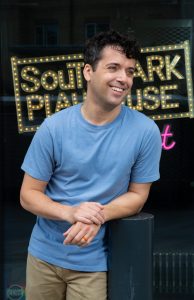
Photo credit: Piers Allardyce
Hi, I’m Marshall! I’m a writer and director, and the father of two saucy young kids and one old but still saucy terrier-mix. I’ve been making plays and musicals since I was a saucy kid in my parents’ basement, and I kind of never stopped. Growing up I studied and practiced many different aspects of the arts – I was a child actor in Broadway musicals, danced Balanchine at the School of American Ballet in New York, went to an acting conservatory for High School, and studied music theory and philosophy at University. So by the time I entered the real world I was fluent in many theatrical languages. For that reason, the various parts of theatrical storytelling, words, music, stagecraft, all live inseparably inside my head – if I’m writing a scene I feel the characters, hear their words and music and see their staging all at the same time. It’s what makes writing and directing make sense to me, though traditionally writing and directing your own musical is probably a pretty terrible idea. 🙂
Where did the idea for Private Jones come from and how was the process of taking this idea from a thought to a production?
I knew I wanted to write a World War 1 epic, and I knew I wanted it from one soldier’s perspective and I wanted that perspective to be unique. So for a while there every once in a while I would google around looking for interesting war stories – one day I stumbled on a couple sentences about a Welsh private named Gomer Jones who was a sharpshooter, deaf, and apparently well liked. Knowing I wanted to direct as well, I was looking for a story where the subject matter would necessitate an interesting staging, and so I immediately starting thinking about the theatrical possibilities – how could we use stagecraft to put the audience inside the shoes of a person in combat who can’t hear the bullets. What would that look like? What would that feel like? What would this boy be like, and how could I use his story to make something of a humanist manifesto, about the ways we value each other and how our pyschology changes when we’re asked to use violence.
And then came the very long process of educating myself – becoming a guest in the Deaf community, and the Welsh community, bringing on collaborators with lived experience and a stake in the writing and representation of their communities on stage. And the literal learning of language – I’m now conversational in ASL, and learning BSL and Welsh.
3. How important is it for you to represent those who are deaf or living with a form of hearing loss?
Very. Of prime importance. Both to authentically reflect the Deaf experience in the writing, and that process began years ago with the collaboration of Alexandria Wailes and the other incredible artists in the Deaf community who helped shape these characters. But it’s also of prime importance to have our Deaf/HoH characters portrayed by actors within the community. We’ve just finished casting, and I can’t wait for London to see what these artists can do.
It’s also important to create a rehearsal process that is multilingual and accessible to all, so there are always multiple interpreters in any rehearsal room. AND, it’s critically important that any audience member, whether they be hearing, deaf or hard of hearing, have access to all information – which is why we have dynamic captioning which every audience member will at some point be using.
4.It is great to see Rose Ayling-Ellis playing a core part in this production, how important is her presence in Private Jones?
Rose is incredible, and also incredibly kind. We’re lucky to have her. She’ll play our Storyteller, the show’s narrator. Rose presents the tale to the audience, but also weaves in and out of the story as various characters and obstacles that challenge our hero along his journey. And as the connection point of the show’s central languages, spoken English and BSL, she represents a shared humanity among disparate cultures.
5. Finally, where do you hope to take Private Jones in the future?
I’d be lying if I said I didn’t have high hopes! We’ve been working very hard on this show for a long time, so I hope it reaches as big an audience as it can. But that relies on us creating something unique, accessible, dynamic and moving. In other words, we have to get it right, and that’s the part I can control, so that’s where I’m putting my energy.
To secure your tickets for Private Jones at Southwark Playhouse Elephant between 14th December-30 January 2027, follow this link: https://southwarkplayhouse.co.uk/productions/private-jones/
