
Hi Jude, could you introduce yourself to Signature readers?
Hello! This is Jude Powell, a 22-year-old English actor and filmmaker. I was born in South London and was hearing at birth, but I became deaf at 18 months old after contracting meningitis, which was life-threatening. I’m a British Sign Language (BSL) user, and I also sometimes use Signed Supported English (SSE). I’m currently based in South Buckinghamshire.
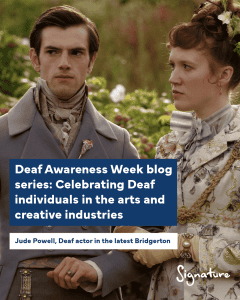
I might be recognisable in the global Netflix hit Bridgerton Season Four, and most of you’re aware that there is a deaf character in Season Three. I’m thrilled to share that there is a new deaf character and actor in Season Four, where I played Lord Allison and used BSL with Lady Allison (Kitty Devlin), his wife, although it is a very small scene that can easily be missed.
Can you tell us a bit more about where your passion for acting came from? Was there anyone in particular who inspired you?
When I was 12 years old, I attended Heathlands School, a deaf secondary school in St Albans, Hertfordshire. That was my very first opportunity to perform on screen with deaf students, and it was for the Into Film Awards. In 2017, this allowed me to walk the red carpet in Leicester Square, London, where I met Daniel Craig, Eddie Redmayne, and others.
In 2019, I decided to join Deafinitely Youth Theatre (DYT) in London for their Summer School when I was 16, and I stayed involved with the company through to 2024, including the autumn term. During this time, I completed the Bronze, Silver, and Gold Arts Award qualifications, which helped me build both confidence and practical performance skills in a supportive, creative environment.
Most recently, I was accepted into the National Youth Theatre (NYT), where I became the first deaf person to complete the Digital Membership course and gain membership. NYT is widely recognised as a world-leading youth arts charity and theatre, and the world’s first youth theatre. This milestone has further strengthened my commitment to acting and inspired me to continue developing my career in the industry.
What does being deaf mean to you personally, beyond how others define it?
To me, honestly, being deaf isn’t just about not hearing sounds. I often wear a hearing aid in my right ear — it’s about experiencing the world in a different rhythm. My first-language communication becomes more visual and intentional, which makes it more exciting to watch and requires more attention and expression, allowing me to feel part of a distinct way of life. My hearing family always find it amazing to watch. When the world isn’t set up for me, it doesn’t define my ability to connect, learn, or belong, as I continue to adapt and find my own way.
What are some adjustments that make the difference when you are working on set?
When I got a role in Bridgerton, I received a special document required for access, called the ‘Passport Access Rider’, which was very useful. It made it clear that I couldn’t avoid it and that it was crucial for me. After I filled everything in with great detail and gave it to the access coordinator, everything went smoothly, which showed me that they had respect and a full understanding.
When I was on the filming set with Kitty Devlin, a crew member told and showed Kitty and me that when Lady Penwood, played by Katie Leung, stepped onto the floor, that was our cue to start our conversation in sign language. I was really happy to know this, as it ensured they wouldn’t block our conversation when they passed and made sure the audience could clearly follow it.
What has it been like being a part of Bridgerton, and how important is it that they represent the Deaf community on such a global stage?
Being part of Bridgerton has been an incredible experience. Fun fact: I didn’t know about or watch Bridgerton before I got the role, but then I watched the whole season. It’s a show that’s not only visually stunning but also really thoughtful about expanding who gets to be seen in period dramas, which have traditionally not been very inclusive. It’s also very important to note that this is one of the most diverse and inclusive series, and it has been excellent and very important.
What’s especially meaningful is how the series represents the Deaf community on such a global platform. That visibility matters a lot. For many Deaf viewers, seeing characters who use sign language in a mainstream, high-profile show can feel both validating and empowering. It also helps hearing audiences engage with Deaf culture in a way that feels natural way. I’ve always believed that working together like this creates something truly amazing.
How did the cast and crew adapt to support communication on set and do you think the industry is improving when it comes to accessibility on set?
Yes, accessibility on set is definitely improving compared to before, but it has not yet reached 100%, and progress remains uneven. However, I feel hopeful and excited to see it continue improving toward full accessibility in the future. The main priority is to strengthen training and awareness, including the use of multiple communication methods such as visual cues, basic sign language, and other inclusive approaches.
It is also important for the industry to have an Access Coordinator who can help identify barriers and create practical solutions to support communication and accessible working conditions for individuals. They were able to provide me with excellent BSL interpreters and BSL consultants when needed. At the same time, people should be asked about their specific needs rather than assumptions being made. For example, tools such as an Access Passport or Access Rider can be used to clearly communicate those requirements.
If you had a dream role you could play, who or what would that be?
My dream role would most often be in film, TV, or theatre as a central character who is fluent in British Sign Language (BSL) and drives the story. I would like to explore a character’s journey and growth throughout the narrative — that’s something I really want to achieve first. I would also love a role that challenges me both emotionally and physically, where I’m pushed as a performer and able to stretch my abilities.
Would you be able to provide some recommendations of deaf representation in TV or other actors you think more people should know about?I have always loved watching television, and I especially enjoy seeing deaf representation in mainstream media. It’s important to me because I love seeing new deaf actors, although I still enjoy watching well-known ones. It would be great to see more opportunities for the next generation of deaf actors.
There is already a strong Deaf representation in both the United States and the United Kingdom. Two films I would highly recommend are CODA, which won an Oscar and is especially powerful for centring Deaf family life and storytelling, and A Quiet Place, which features Deaf actor Millicent Simmonds and brings an authentic Deaf experience into a mainstream thriller.
In the UK, ITVX’s Code of Silence and BBC’s Reunion are other excellent examples of thoughtful Deaf representation on television.
It is difficult to choose just one Deaf actor to highlight, as there are many talented performers. However, having worked with Deaf talent, I would especially mention Sophie Stone, with whom I worked on The Chelsea Detective, and whose work across theatre and television continues to stand out
Finally, what advice would you give to your younger self and others in the Deaf community who are looking to pursue a career in the arts?
I would say: don’t wait for everything to be perfectly accessible before you begin. Start where you are and grow from there. The industry is slowly improving, and more Deaf creatives are becoming visible, which is creating more space for others to follow.
And if an opportunity comes your way — even a small one — take it. You never know where it might lead or how important it could become later on. It’s also important to stay open-minded about opportunities.
Most importantly, keep developing your skills and confidence at the same time as you’re gaining experience. Progress doesn’t always happen in a straight line, but every step can move you forward.
Thank you to Jude for taking the time to share his experiences and insights with us. Jude’s story is a powerful reminder of what BSL means to so many people. If you’d like to learn BSL yourself, explore our British Sign Language qualifications and find a course near you.
