Signature Recruit a Working Group
We began researching and collating information with a working group. This group was made up of respected professionals in education and Deaf communication, as well as representatives from awarding bodies that had experience in creating qualifications for secondary education.
With the help of this working group, we wrote a draft of the qualification specification content, along with all the necessary support materials and documents needed for the next steps.
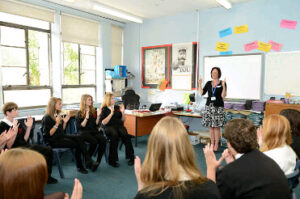
We Pilot the BSL GCSE in Six Secondary Schools
Following an overwhelmingly positive response from schools and teachers across the country, we chose six secondary schools to pilot our proposed BSL GCSE qualification.
- St Clere’s School, Essex
- Sanders School, Essex
- Oak Lodge School, London
- Darrick Wood Secondary School, Kent
- Chatham and Clarendon Grammar School, Kent
- Blackburn College, Blackburn
The feedback from these schools would prove invaluable.
The Launch of ‘Right to Sign’
2017 marked the beginning of a significant campaign — the National Deaf Children’s Society (NDCS) ‘Right to Sign’. It was developed in the hope that the UK government would agree to introduce a GCSE in BSL.
It spread the word about a potential GCSE in British Sign Language and planted the seed of potential.
UK Government Rejects the BSL GCSE, and We Push Forward
Our first major setback. Nick Gibbs, Minister for School Standards at the Department for Education, rejected the idea of a GCSE in British Sign Language. He believed it didn’t fit the current framework for modern foreign language offerings in secondary education.
However, we didn’t give up.
Florence from NDCS’s Young Advisory Board met with civil servants at the Department for Education and educated them on how a British Sign Language qualification could benefit young people — Deaf and hearing.
Deaf young person, Daniel Jillings, accompanied by his mum, Ann, also met with Nick Gibbs to discuss the campaign for a GCSE in British Sign Language.
Wayne Barrow Launches Successful Parliament Petition, and Conversations Grow
TV and media presenter, Wayne Barrow, sparked the conversation of a BSL GCSE into the limelight again. He launched a successful parliament petition urging the government to make British Sign Language a part of the National Curriculum.
Wayne Barrow, as well as NDCS and the release of the Oscar-winning film, The Silent Child, all played a huge role in encouraging ongoing conversations about a potential BSL GCSE.
As a result, Daniel Jillings launched a crowdfunding campaign to cover the legal costs needed to challenge the government's delay in approving the new qualification.
We Prepare Two Proposals for the Department for Education (DfE)
Word got around.
We met with an independent regulator of qualifications and assessment, Ofqual, and the Department for Education to discuss the recent campaigns and developments in favour of a GCSE in BSL.
By the end of the meeting, we were asked to prepare two proposals to develop the qualification, which we delivered in November 2018.
At this point, the Department for Education confirmed that they were working with subject experts to develop GCSE content and aimed to introduce it to the curriculum as soon as possible.
Work Continues Throughout COVID-19
The COVID-19 pandemic struck the world, causing delays in progress. However, the Minister for Schools and Childhood, MP Kelly Tolhurst, confirmed that work was ongoing, subject content was being drafted, and a public consultation would begin soon.
GCSE in BSL Consultation Begins, and Results Are Published
The BSL GCSE consultation began. This provided us with critical feedback on our proposal, which allowed us to refine and enhance any content requirements that would form the basis of the new GCSE.
Shortly after, the government published the consultation results and responses, with strong support in favour of the GCSE. The department received 717 responses, with views expressed about the new qualification's positive outcomes.
Wales Suspends GCSE in BSL
In October 2024, Qualifications Wales announced that it had suspended the development of its GCSE in British Sign Language in Wales. The reason was that there were too ‘many practical challenges for the educational sector as a whole’.
Ofqual Provides Reassurance
Ofqual provided reassurance about its ongoing work and ensured that the assessment methodology would be appropriate for a GCSE qualification in BSL.