
Georgia Meacham is a British actor, model and advocate who through her work and social presence, champions inclusivity and representation on screens and in society. Born deaf and navigating a world where representation was rare, Georgia built her career while facing challenges she often kept unseen. Today, Georgia uses her platform to celebrate accessibility and champion the deaf community. Throughout this blog, Georgia explores her early career and the impact she is determined to make.
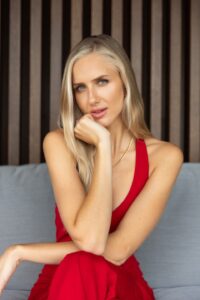
- Can you tell us a bit about your experiences growing up as someone who is deaf?
I was born deaf and grew up wearing two hearing aids, but I didn’t know sign language, so I had no connection to the Deaf community. My parents worked hard to put me into a small private mainstream school because I would have really struggled in a large public classroom without support. I was the only deaf child in my primary school, then again in secondary school, and later at university on my course. That constant lack of representation made me feel very isolated, because I never had anyone who truly understood my experience. I learned to work twice as hard just to keep up, and the frustration of not hearing teachers the first time became normal to me. I did well academically and I am proud of that, but as I got older, especially in my teenage years and at university, I became more aware of how different I was. The loneliness came from knowing I was facing challenges quietly and on my own.
2. How did you get into modelling and how has this experience been as a deaf individual?
I started modelling when I was 16, and I absolutely loved the excitement of working on weekends and being on set. But at that time, I felt I had to hide my deafness to fit into the industry. I would take my hearing aids out during photoshoots or hide them on the catwalk because disability was not something the fashion world accepted or celebrated. This created a lot of shame around my hearing aids, as if they didn’t belong in the image of beauty. I worked with big brands like TedBaker and Karen Millen, and because I often removed my hearing aids, I depended heavily on lip-reading on busy sets. That’s when I really experienced listening fatigue and the mental exhaustion of masking. I pretended I didn’t need any accessibility, even though I did. The industry is slowly changing, and I am grateful for that, but there is still a long way to go. Disabled models shouldn’t exist just to tick a diversity box, we should be valued as part of the industry.
3. What advice would you give to industry professionals who want to be deaf-aware on set?
The most important thing is to ask, rather than assume. Ask if the deaf person has any accessibility requirements, including things like preferred communication or positioning. Make sure you’re speaking clearly and not covering your mouth, because many of us rely on lip-reading. Captions should be a standard requirement for screenings, premieres, and video content, not an afterthought. In auditions or rehearsals, keep the reader or script partner close enough to see clearly. Small adjustments can make a huge difference, and none of them are difficult. Deaf awareness isn’t just about one person, it shapes the environment and shows respect. There is still a huge amount of work to do, and I am committed to being part of that change. Inclusion should be built in, not added on at the end.
4. What changes would you personally like to see when it comes to accessibility in castings and auditions?
I would like to see everything I mentioned earlier become standard, not optional. Beyond that, I would love to see casting calls actually state that deaf and hard of hearing actors are welcome, instead of assuming we will just apply. I also think all scripts or slides should be sent in advance so deaf actors aren’t processing new information in a rushed room with no support. Another change would be having at least one deaf aware or access trained person in the room, so the responsibility doesn’t fall on the deaf actor to educate everyone while trying to perform. I would also like to see more deaf creatives behind the camera, not just in front of it. And finally, I want to see accessibility treated as a creative tool, not an inconvenience. Inclusion improves storytelling for everyone.
5. If you could give your younger self some key pieces of advice, what would they be?
I would tell my younger self to stop hiding what makes her different, because one day she will realise it is her biggest strength. Being deaf has made me kinder, more observant, and more empathetic, even when I didn’t realise it. I would reminder her that every time she speaks up for herself, she is not just doing it for her own benefit, she’s helping an entire community of people who feel unseen. I would tell her that the shame she feels now will one day turn into pride, and that the world needs her perspective. She doesn’t need to work so hard to fit in, standing out is much cooler!
6. You recently appeared on Good Morning Britain sharing more about your experience being deaf in the creative industry. What sort of response did you receive from this?
The response was incredibly positive, and honestly, I didn’t expect it. I went on the show at a time when my mental health was really low, and doing that interview was something I mainly did for myself, to finally speak openly instead of hiding. It was the first time I felt real pride in being deaf, and I realised how powerful it is to share your story. After the interview, I received so many messages from deaf people, parents of deaf children, and even hearing people who just wanted to understand more. That made me realise how one voice can make a difference. It gave me clarity that advocacy and visibility matter far more than I ever understood before.
7. Going forward, what do you hope to achieve, in your career and in your personal life?
In my career, I want to work on campaigns and roles that actually reflect the world we live in. One goal of mine is to do a jewellery campaign that celebrates wearing hearing aids, showing them alongside earrings and accessories instead of hiding them. I want to do more TV and film roles that show deaf characters as whole people, not stereotypes. Personally, I am committed to advocating for the deaf community in every space I can. I started my British Sign Language Level 1 last month, thanks to Signature, and that feels like a huge step in finally connecting with a community I was never given growing up. My goal is simple: more visibility, more vulnerability, and more pride, both for myself and others.
Here at Signature, we would like to thank Georgia for sharing her story with us. From hiding her deafness in her youth, to using her platform to break barriers in the creative industry. Georgia is committed to representation and accessibility, and we look forward to watch her flourish further in future endeavours.